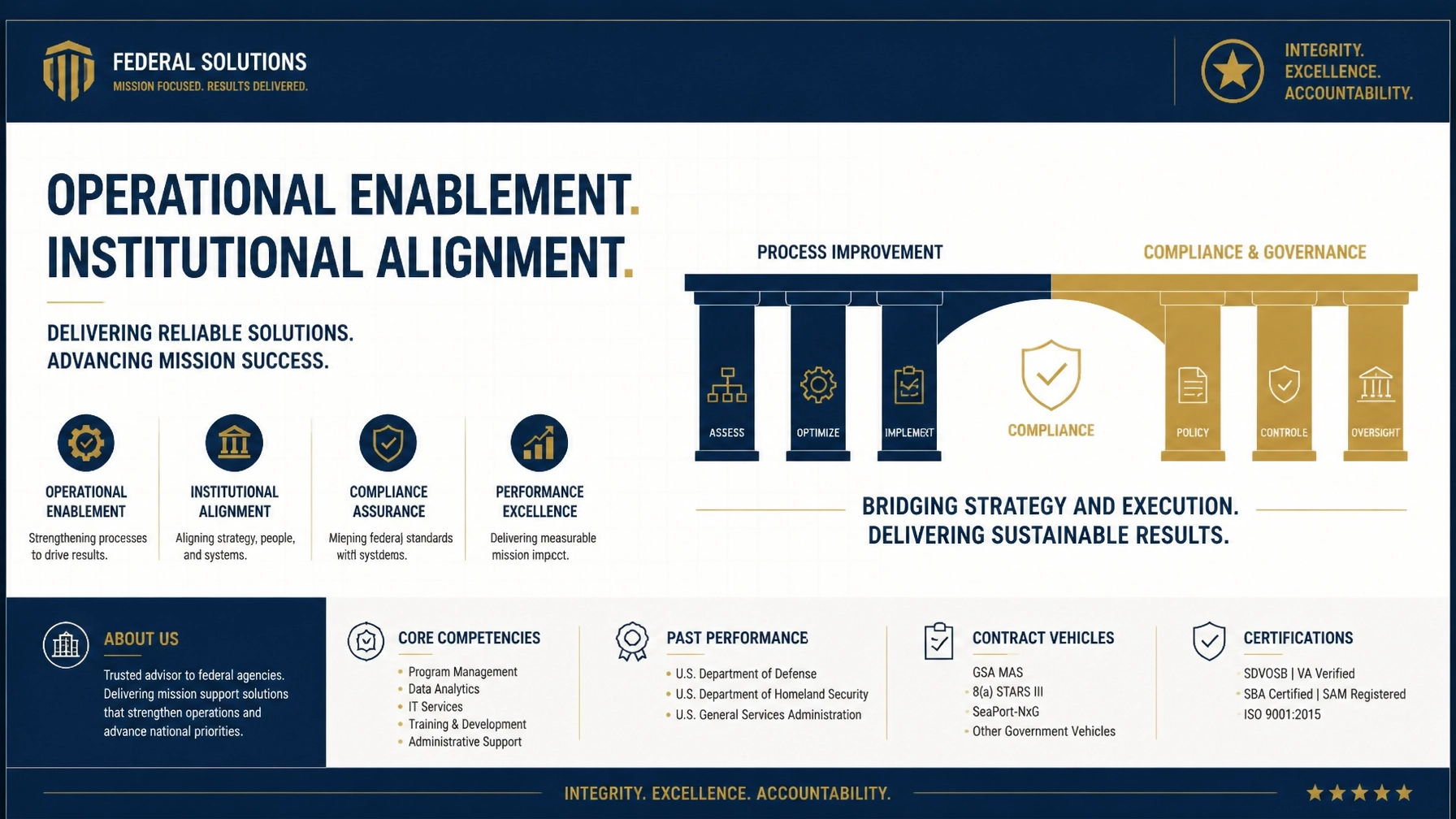
Summary: This article explains how Walton Global Enterprise (WGE) is aligning its federal support model around the Walton Gold Standard and the Architecture of Accountability. Readers will see how structured process improvement, governance architecture, and operational enablement support de-risked institutional delivery in regulated environments.
The Problem: The High Cost of Operational Friction
Federal agencies and institutional partners often face a critical disconnect between high-level mission goals and ground-level execution. This gap, known as "operational friction," occurs when legacy processes are forced to comply with evolving regulatory requirements without a corresponding update to internal workflows. In many cases, compliance is treated as a reactive checklist: a hurdle to be cleared: rather than a proactive design element.
When operations are fragmented, organizations experience:
- Process Redundancy: Multiple departments performing overlapping tasks with different standards, leading to wasted man-hours.
- Knowledge Gaps: Workforce turnover leading to "institutional amnesia" where critical compliance knowledge is lost as personnel exit.
- Inconsistent Data: Reliance on manual workarounds and "shadow systems" that compromise audit readiness and data integrity.
The Impact: Mission Risk and Audit Failure
Ignoring operational friction creates significant risk. In a federal environment, the cost of inefficiency is not just monetary: it is a risk to mission integrity and public trust. Without structured operational enablement, agencies face a cascade of failures:
- Increased Audit Findings: Inconsistent documentation leads to non-compliance during GAO or IG audits.
- Resource Drain: High-value personnel spend more time correcting historical errors than executing current mission-critical tasks.
- Scalability Barriers: Systems that cannot adapt to new mandates without complete disruption of daily services.
According to the GAO Green Book, internal controls are essential for achieving an entity's objectives. When these controls are not "engineered" into the daily operation, the "Shield" of compliance is weakened, leaving the agency vulnerable to regulatory scrutiny and operational paralysis.
The WGE Approach: The Oversight Engine™ and the Institutional Shield
At Walton Global Enterprise (WGE), we believe that compliance is not a burden to be managed: it is the natural result of an optimized operation. Our strategic pivot centers on a simple but powerful narrative: The Institutional Gold Standard is powered by the Oversight Engine™ and reinforced by Governance Architecture through the Institutional Shield. This is how we support De-risked Institutional Delivery in regulated, high-impact environments.
About Us: Institutional Alignment Through Discipline
WGE delivers the Institutional Gold Standard in Regulated Performance through our proprietary Architecture of Accountability.
Our methodology is rooted in Institutional Alignment. This means ensuring that your people, your processes, and your technology are all moving in the same direction, backed by documented accountability and clear ownership. The Architecture of Accountability serves as our primary framework for de-risking program delivery, helping clients pivot when mandates change without losing operational control or audit readiness.

Services Realignment: The Three Pillars of Support
To support this narrative, WGE has realigned our core services into three distinct but interconnected pillars. This realignment ensures that we provide end-to-end support, from the initial design of a process to the final audit-ready documentation.
1. The Institutional Gold Standard (The Oversight Engine™)
We use data-driven methodologies to identify waste and optimize delivery. Our Oversight Engine™ is powered by two primary frameworks:
- Lean Six Sigma (LSS): We apply LSS to federal workflows to reduce variation and eliminate non-value-added steps. Whether it is shortening procurement cycles or streamlining grant management, we map the process to ensure every action contributes directly to the mission outcome.
- ADDIE Model for Operational Design: We utilize the ADDIE (Analyze, Design, Develop, Implement, Evaluate) framework to build structured operational plans. This ensures that new processes are not just theoretically sound but are practically implementable, measurable, and auditable.
2. Workforce Transformation & Change Management
A process is only as good as the people executing it. WGE focuses on Workforce Transformation to ensure your team is equipped for the future of federal work. We recognize that change can be disruptive in an institutional setting, which is why our approach is gradual and structured.
- Change Management: We guide organizations through the cultural shift required for The Institutional Gold Standard in Regulated Performance, focusing on buy-in from both leadership and staff.
- Operational Enablement: We provide the training, SOPs, and digital tools necessary for staff to take ownership of their roles. This reduces the need for constant management oversight and increases overall mission velocity.

3. Governance Architecture (The Institutional Shield)
The Institutional Shield ensures that your operational engine stays within the lines of federal law, agency policy, and internal controls. Our governance services are designed to make compliance visible, structured, and repeatable through the Architecture of Accountability.
- Regulatory Alignment: We build compliance into the process from day one, ensuring that every step produces the documentation required for audit readiness.
- Governance Frameworks: We establish clear lines of authority and performance tracking. As seen in our 4R’s Active Bidding Process, we believe in a continuous cycle of Research, Respond, Results, and Repeat to maintain a disciplined delivery model.

Procurement Readiness: The NAICS Narrative
WGE’s positioning aligns with common procurement pathways used for process improvement, operational support, and technology-enabled delivery. For buyers and partners reviewing capability fit, our NAICS narrative includes 541611, 541618, and 541519 as practical indicators of how this work is scoped and acquired in federal environments.
Practical Takeaways for Federal Program Managers
If your program is struggling with efficiency or audit anxiety, consider these immediate steps for your next internal review under The Institutional Gold Standard in Regulated Performance:
- Map Your Critical Path: Identify the three most important steps in your delivery cycle. If these aren't documented and measurable, they represent your biggest operational and compliance risk points.
- Audit Your "Shadow Systems": Look for manual spreadsheets or "off-book" processes your team uses to get work done. These are indicators that your formal process is failing and needs realignment.
- Define Ownership with Precision: For every critical task, there should be one owner and one backup. Use a RACI (Responsible, Accountable, Consulted, Informed) matrix to eliminate confusion and increase accountability.
- Prioritize Standardized Training: Use a structured model like ADDIE to ensure your workforce understands why a compliance step exists, not just how to perform it. Documented training is a key defense during audits.
When to Bring in WGE
WGE is most effective when an organization is facing a period of significant change or heightened scrutiny. You should engage professional vendor support when:
- You are launching a new, high-impact program that requires immediate "day one" compliance and operational setup.
- A recent audit has identified systemic weaknesses in your operational controls or data integrity.
- Your current processes cannot scale to meet new federal mandates or significant increases in program funding.
- You need to transition from a "reactive" compliance posture to a "proactive" Institutional Gold Standard model supported by the Architecture of Accountability.
For more information on our specific capabilities and how we can support your mission, visit our About Us page or review our Contracting Opportunities.

Soft CTA: Review Your Current Framework
The Walton Gold Standard is built through disciplined execution, not slogans. We suggest reviewing your current internal controls and process maps. Are they supporting de-risked institutional delivery, or are they creating friction? If you are preparing for your next audit cycle or planning a workforce transformation, make sure your Oversight Engine™ and Institutional Shield are properly aligned through an Architecture of Accountability. Start by reviewing your current processes or contact us to discuss how Walton Global Enterprise can provide the structured support your agency needs.
Metadata Description: Walton Global Enterprise explains how The Institutional Gold Standard and the Architecture of Accountability help federal agencies improve process control, strengthen governance architecture, and support de-risked institutional delivery.
Keywords: The Institutional Gold Standard, Architecture of Accountability, Strategic Program Governance, Governance Architecture, De-risked Institutional Delivery, Operational Enablement, Institutional Alignment, NAICS 541611, NAICS 541618, NAICS 541519
Leave a Reply