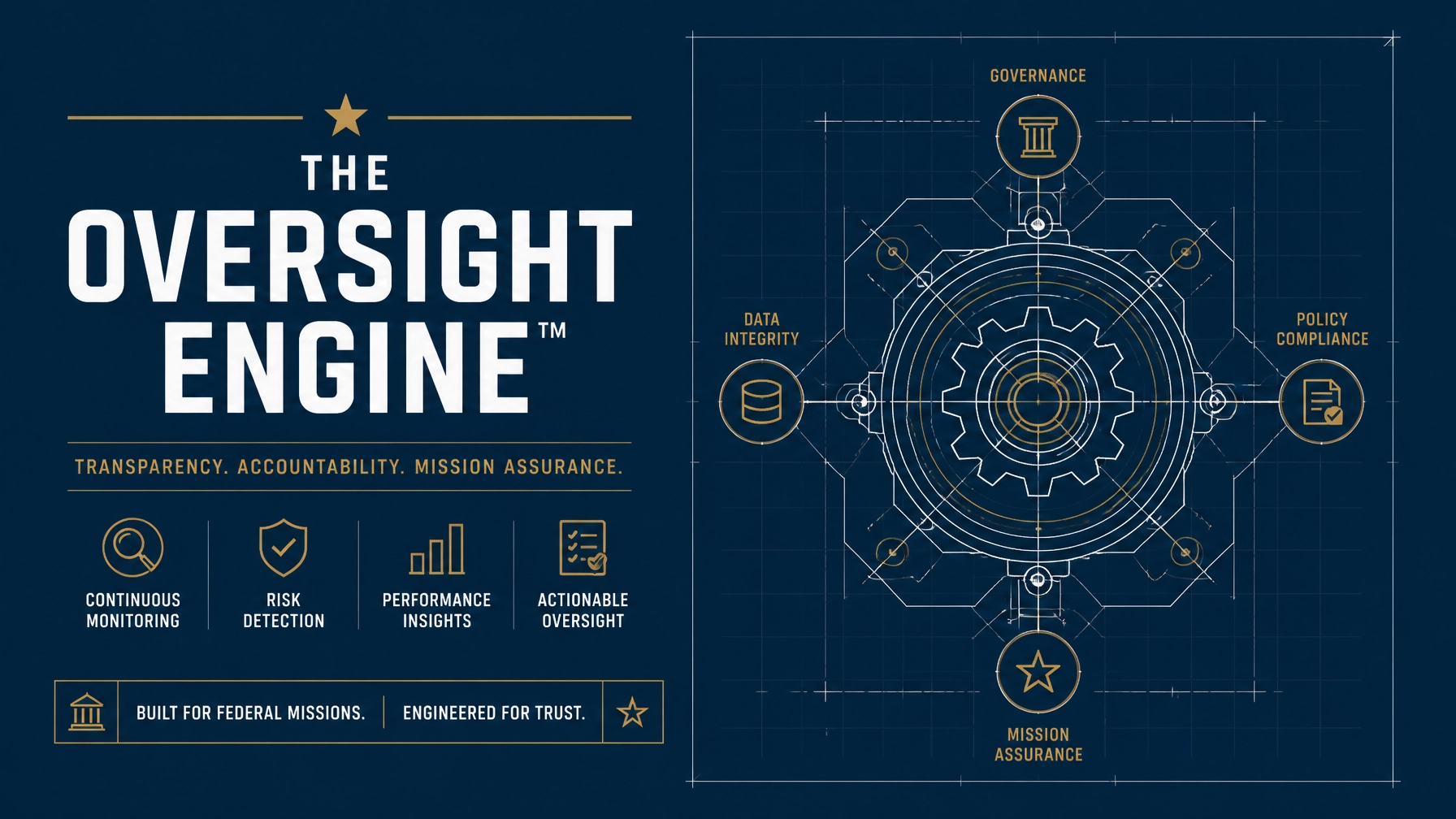
Summary: This executive brief explores the critical transition from standard program modernization to "audit-ready" leadership within the Department of Health and Human Services (HHS) and the Department of Veterans Affairs (VA). Readers will discover how Walton Global Enterprise (WGE) leverages The Oversight Engine™ to convert institutional discipline into measurable, accountable mission success.
For leadership at agencies like the Department of Health and Human Services (HHS) and the Department of Veterans Affairs (VA), "modernization" has become a ubiquitous term. However, modernization without a foundation of accountability is simply a faster way to reach the same systemic bottlenecks.
As we look toward the 2025 federal landscape, the pressure to deliver results is no longer just about meeting mission milestones: it is about surviving the scrutiny of the GAO High-Risk List and ensuring that every dollar spent is auditable, defensible, and effective.
The Problem: The High-Risk Stagnation Trap
The Government Accountability Office (GAO) continues to flag critical HHS and VA programs on its High-Risk List. For HHS, the challenges center on Medicaid and Medicare improper payments: exceeding $100 billion: and the oversight of medical products and food safety. For the VA, the risk drivers remain consistent: ambiguous policies, inconsistent processes, and inadequate oversight of health care and acquisitions.
The underlying issue isn’t a lack of effort or technology; it is a lack of Institutional Discipline.
Many agencies fall into the "modernization trap": spending billions on new IT systems or Electronic Health Record (EHR) transitions while neglecting the operational frameworks required to manage them. Without structured governance, these new systems become "black boxes" that hide inefficiencies rather than solving them. This creates a significant gap between strategic intent and audit readiness, leaving program managers vulnerable to waste, fraud, and mismanagement findings.

The Impact: Beyond the Bottom Line
The risk of ignoring these structural gaps extends far beyond a negative report. In regulated, high-impact environments like federal healthcare, the impact of operational misalignment is three-fold:
- Financial Vulnerability: Improper payments and unchecked acquisition costs lead to budget clawbacks and restricted future funding.
- Operational Paralysis: When oversight is reactive rather than proactive, program leaders spend more time defending past decisions than executing future ones.
- Loss of Institutional Trust: Persistent presence on the GAO High-Risk List erodes the trust of Congress and the public, making it increasingly difficult to secure the human capital and resources needed for long-term mission success.
To exit this cycle, leaders must move beyond the "checklist" mentality of compliance and adopt a system-architect approach to governance.
The WGE Approach: The Oversight Engine™
At Walton Global Enterprise (WGE), we believe that compliance is not a goal: it is the natural byproduct of a well-engineered process. We solve these high-stakes federal challenges through The Oversight Engine™ and our proprietary Architecture of Accountability™.
1. The Architecture of Accountability™
We don’t just offer advice; we build the framework. The Architecture of Accountability™ is a multi-layered governance model that aligns high-level strategy with granular operational controls. It ensures that every role is defined, every process is documented, and every performance metric is tied to a specific audit requirement.

2. Driving Results via The Oversight Engine™
The Oversight Engine™ is our operational enablement framework. It shifts the focus from monitoring to mastery. By treating program management as a discipline rather than a task, we help agencies:
- Standardize the Unstandardized: We target and minimize policy ambiguity by creating clear, enforceable operational manuals that align with federal regulations.
- Implement Proactive Controls: We build internal controls that detect discrepancies in real-time, long before they become improper payments or audit findings.
- Ensure Institutional Discipline: We instill a culture of documentation and performance tracking that ensures the "adults are in the room" at every stage of the contract lifecycle.
Practical Takeaways for HHS and VA Leaders
Moving your program off the High-Risk List requires an immediate shift in operational philosophy. Here are four steps to begin building your own oversight engine:
- Audit Your Processes, Not Just Your Data: Before your next audit cycle, review the how of your operations. Are your processes documented, repeatable, and independent of specific personnel?
- Map Every Dollar to a Control: Ensure that every major expenditure: especially in Medicaid/Medicare or VA Acquisitions: is governed by a documented internal control that satisfies GAO standards.
- Pivot from Modernization to Enablement: If you are implementing a new IT system (like the VA's EHR), ensure that the operational change management is as robust as the software deployment.
- Establish a "Source of Truth" for Performance: Use data integrity as your primary metric. If your performance data isn't auditable, it isn't useful.

When to Bring in WGE
Professional vendor support becomes necessary when the complexity of the mission outpaces the agency's current capacity for disciplined oversight. If your program is:
- Preparing for a high-stakes audit or responding to a GAO High-Risk finding.
- Managing a complex, multi-billion dollar acquisition or IT transition.
- Facing significant "improper payment" challenges that require deep-dive operational cleanup.
WGE provides the structured consulting and compliance-first operations needed to secure your mission’s legacy. We don't just help you comply; we help you lead.
Soft CTA: Strengthen Your Foundation
The first step toward audit readiness is an honest assessment of your current institutional discipline. We suggest reviewing your current operational processes or starting a dialogue with your compliance team regarding your next audit cycle preparation.
To learn more about how we bridge the gap between strategic vision and operational excellence, visit our Vision page.
Leave a Reply