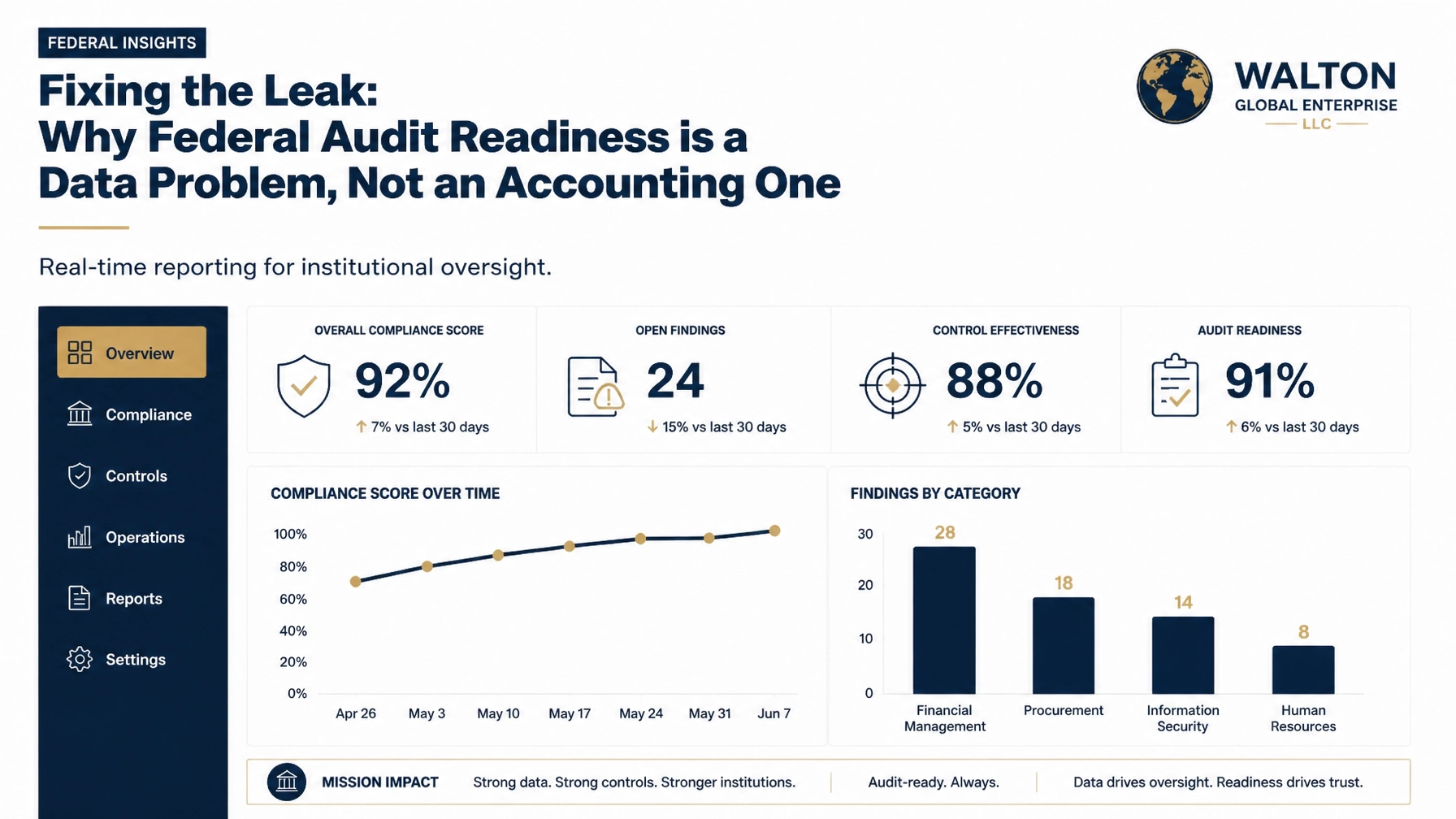
The landscape of federal and institutional oversight is undergoing a fundamental shift. For decades, the standard for program governance has been the static monthly report: typically a PDF or spreadsheet delivered weeks after the reporting period ends. However, in high-stakes environments where regulatory compliance and operational efficiency are non-negotiable, the limitations of retrospective reporting have become a significant liability.
As government agencies and large-scale institutions face increasing pressure for transparency and rapid response, the transition toward real-time reporting portals is no longer an optional upgrade; it is a structural necessity. This evolution represents a move from reactive administration to proactive strategic leadership, where decision-makers rely on live data streams rather than historical summaries.
The Limitations of Legacy Oversight: Why Static Reports Fail Modern Programs
Historically, the "Monthly Status Report" (MSR) has served as the primary mechanism for accountability. While useful for documentation, the static nature of these reports creates several critical friction points:
- The Information Lag: A report delivered on the 10th of the month detailing the previous month’s activities is, by definition, 10 to 40 days behind the reality on the ground. In a regulated environment, a compliance breach or an operational bottleneck that persists for 30 days can escalate into a systemic failure.
- Fragmented Data: Static reports are often siloed. Financial data exists in one document, staffing metrics in another, and performance milestones in a third. Connecting these data points manually is labor-intensive and prone to human error.
- Lack of Interactivity: A PDF is a dead document. Stakeholders cannot "drill down" into a specific metric to understand its root cause. This lack of transparency often leads to additional inquiry cycles, slowing down the pace of program execution.

For high-impact programs, these delays translate directly into increased operational risk. When oversight is retrospective, the agency is always looking in the rearview mirror. True operational accountability requires the ability to identify and remediate issues as they emerge, not weeks after they have concluded.
The Shift Toward Dynamic "Self-Service" Visibility
The modern alternative is the real-time reporting portal: a centralized, dynamic environment (often powered by platforms like Looker Studio, Power BI, or custom-built dashboards) that integrates disparate data sources into a single pane of glass.
This shift provides "self-service" visibility, allowing institutional leads to access the information they need at any moment without requesting a manual update from the contractor or program manager.
Key Advantages of Real-Time Portals:
- Immediate Anomaly Detection: Dashboards can be configured with automated triggers. If a spending threshold is approached or a compliance deadline is nearing, the system alerts stakeholders immediately.
- Unified Truth: By consolidating data from financial systems, project management tools, and compliance logs, portals ensure that all parties: government leads and consulting partners: are looking at the same numbers in real-time.
- Audit Readiness: Continuous monitoring creates a persistent audit trail. Instead of scrambling to compile documentation for a quarterly review, agencies maintain a state of permanent readiness.
At Walton Global Enterprise (WGE), we specialize in bridging the gap between high-level vision and granular execution. Our approach to Strategic Advisory & Enablement prioritizes the implementation of these governance layers, ensuring that our partners have the tools necessary for disciplined execution.
Reducing Operational Risk Through Compliance-Aware Delivery
In regulated industries, compliance is not a checkbox; it is an ongoing operational state. Traditional monthly reviews often treat compliance as a post-mortem activity. Real-time portals change this dynamic by integrating compliance support directly into the daily workflow.
When oversight is continuous, the risk of non-compliance is significantly mitigated. For example, in a program managing federal grants or infrastructure projects, a real-time portal can track labor categories, wage rate adherence, and milestone progression simultaneously. If a deviation occurs, it is flagged instantly, allowing for immediate corrective action.

This "compliance-aware delivery" model ensures that every action taken within the program is aligned with the regulatory framework. It moves the burden of oversight from manual inspection to automated governance, freeing up agency leaders to focus on mission-critical initiatives rather than administrative policing.
Positioning for Performance: The WGE Governance Layer
Implementing a real-time reporting infrastructure is complex. It requires more than just software; it requires a deep understanding of federal procurement cycles, data integrity, and institutional requirements.
Walton Global Enterprise, LLC serves as the expert governance layer for agencies and institutions. We do not just provide "reports"; we build the operational systems that enable operational accountability. Our services are structured to provide:
- Program & Operations Support: We manage the data pipelines and coordination efforts that feed these reporting portals.
- Compliance & Governance: We ensure that the data being reported is accurate, documented, and meets all internal controls and oversight requirements.
- Strategic Leadership: We help program leaders interpret live data to make informed, high-stakes decisions that align with long-term mission goals.
By moving away from the static review cycle, organizations can achieve a level of transparency that was previously impossible. This transparency builds trust between the agency and the partner, as performance is no longer a matter of interpretation: it is a matter of documented, real-time fact.

Conclusion: The Future of Institutional Oversight
The evolution of oversight is moving toward a model where data is fluid, accessibility is instant, and compliance is integrated. Static monthly reviews, while still necessary for formal record-keeping, are no longer sufficient for the active management of complex programs.
For government agencies and institutional leaders, the transition to real-time reporting portals is a strategic imperative. It reduces lag, minimizes risk, and empowers leaders with the visibility required for modern governance. Walton Global Enterprise, LLC is committed to delivering this high-impact support, ensuring our partners operate with the structure, accountability, and discipline that regulated environments demand.
Corporate Information
Walton Global Enterprise, LLC (WGE)
Government Consulting & Compliance Services
CAGE Code: 16PW4
UEI: VKVCWMMQ6JD6
Primary NAICS Codes:
- 541611 – Administrative Management and General Management Consulting Services
- 541618 – Other Management Consulting Services
- 541990 – All Other Professional, Scientific, and Technical Services
Contact for Procurement: waltonglobalenterprise.com/contact
Leave a Reply