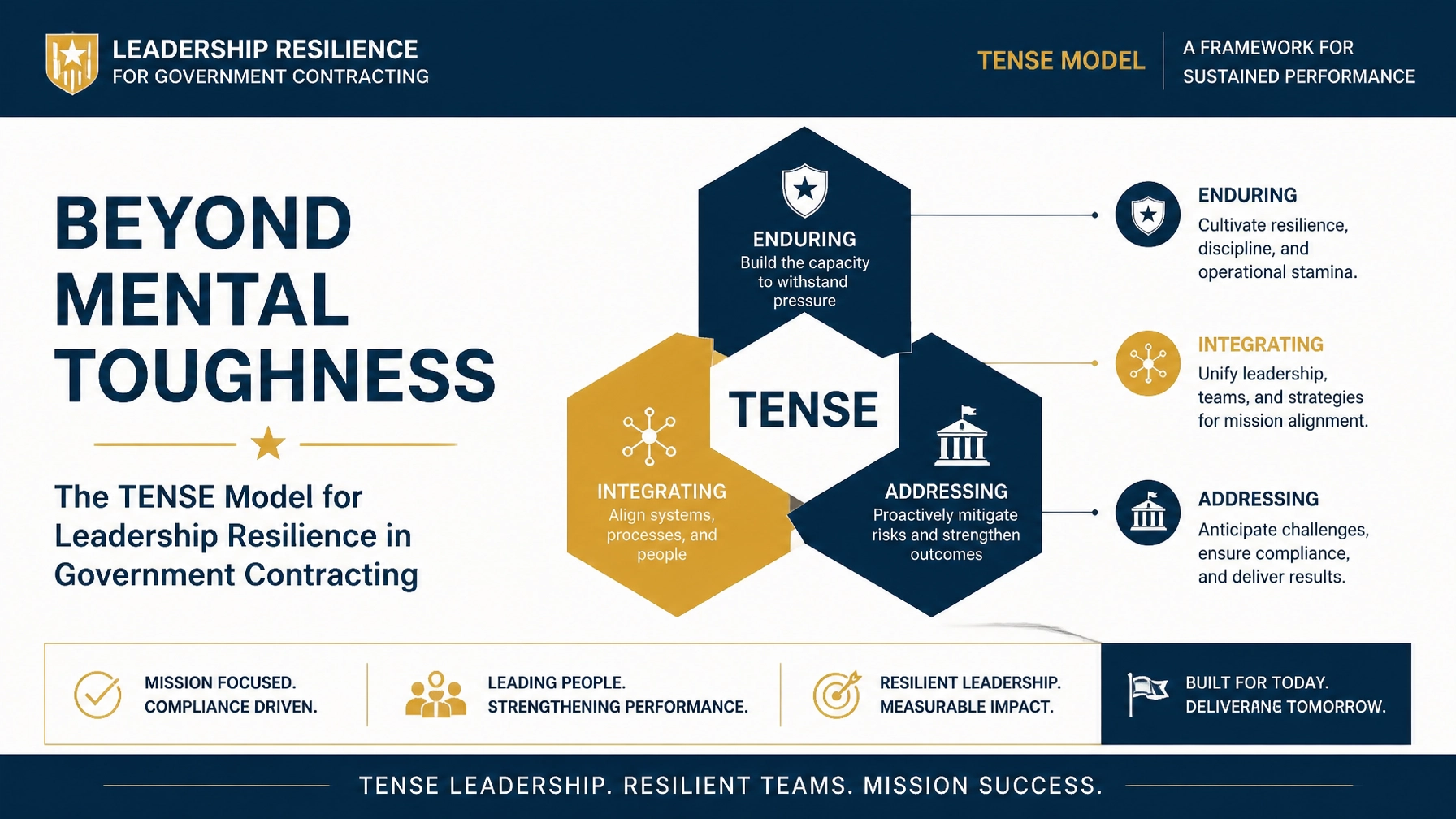
In the current landscape of government contracting and institutional leadership, the traditional concept of "mental toughness" is proving insufficient. While the ability to withstand pressure: often described as "gritting one's teeth": is a baseline requirement, it does not account for the structural complexity of regulated environments.
As part of The Architect Series, this article examines the shift from individual persistence to structural resilience. True leadership in high-impact, regulated sectors requires an architectural approach to managing paradoxes. This transition is codified in the 2026 TENSE Model, which focuses on three core pillars: Enduring, Integrating, and Addressing tensions.
The Limitation of Traditional Mental Toughness
For decades, leadership development emphasized personal stamina. However, in the context of government consulting and compliance services, relying solely on individual willpower leads to operational bottlenecks and executive burnout.
Strategic leadership requires more than endurance; it requires Paradoxical Leadership. This is the ability to balance competing demands: such as strict regulatory compliance versus the need for operational flexibility: without compromising the mission.

The TENSE Model: A Framework for Strategic Resilience
The 2026 TENSE research model provides a structured methodology for leaders to navigate the inherent frictions of institutional environments. Rather than attempting to eliminate tension, the Architect-leader designs systems to leverage it.
1. Enduring Tensions: The Inner Capacity
The first pillar, Enduring, refers to the capacity to maintain performance and composure under sustained regulatory pressure. In procurement and program execution, timelines are often rigid and oversight is continuous.
- Composure Under Scrutiny: Maintaining a neutral, authoritative presence during audits or high-stakes mission reviews.
- Regulatory Stamina: The ability to sustain long-term compliance efforts without descending into procedural fatigue.
- Emotional Regulation: Managing the internal system’s anxiety so it does not propagate through the organizational hierarchy.
2. Integrating Tensions: The Both-And Approach
The second pillar, Integrating, involves harmonizing competing operational priorities. In regulated spaces, leaders often face "either/or" fallacies: Compliance vs. Innovation, or Control vs. Agility.
The Architect-leader utilizes Integration to create systems where compliance is not a barrier to innovation but a framework for it.
| Traditional Approach (The Grinder) | Architectural Approach (The Architect) |
|---|---|
| Views compliance as a hurdle. | Uses compliance as a structural baseline. |
| Reacts to regulatory changes. | Integrates regulatory updates into the core workflow. |
| Chooses between speed and safety. | Designs safe systems that allow for high-speed execution. |

3. Addressing Tensions: Proactive Operational Resolution
The final pillar, Addressing, is the active surfacing and resolution of operational paradoxes. This is where strategic advisory and enablement become critical. Addressing tensions means identifying where the system is failing to balance control and flexibility and re-engineering the process.
- Transparent Communication: Clearly identifying when a compliance requirement is impacting operational speed.
- Governance Mapping: Creating clear lines of ownership and accountability for every tension point.
- Continuous Recalibration: Using data-driven feedback loops to adjust the balance between autonomy and oversight.
Paradoxical Leadership in Regulated Environments
Walton Global Enterprise, LLC (WGE) operates within the intersection of high-impact delivery and disciplined compliance. This requires a leadership mindset that views regulation as a competitive advantage. When a leader masters the TENSE model, they move from being a "task manager" to an "architect of resilience."
In government contracting, specifically within NAICS codes 541611 (Administrative Management and General Management Consulting) and 541618 (Other Management Consulting Services), the ability to integrate these tensions directly impacts program success and institutional trust.

Implementing the Architect’s Mindset
To transition from standard mental toughness to the TENSE model of resilience, leaders should focus on the following structural adjustments:
- Define the Paradoxes: Map out the primary tensions in your current contract or program. (e.g., Security vs. Accessibility).
- Audit Your Enduring Capacity: Determine if your team has the resources to sustain the current level of pressure without quality degradation.
- Build Integrative Workflows: Implement standard operating procedures (SOPs) that automate compliance, allowing the team to focus on mission-critical execution.
- Establish "Addressing" Protocols: Create formal channels for surfacing tensions before they become operational failures.
Conclusion: Designing for Resilience
Leadership resilience in 2026 is a design challenge, not a character trait. By mastering the TENSE model: Enduring, Integrating, and Addressing: leaders can build organizations that are not only compliant but structurally resilient to the fluctuations of the regulated market.
Walton Global Enterprise, LLC remains committed to providing the structured program delivery and operational accountability necessary for modern institutional success.
Corporate Capabilities & Identifiers
- Company Name: Walton Global Enterprise, LLC
- CAGE: 16PW4
- UEI: VKVCWMMQ6JD6
- NAICS Codes: 541611, 541618, 541990
- Website: www.waltonglobalenterprise.com
Leave a Reply