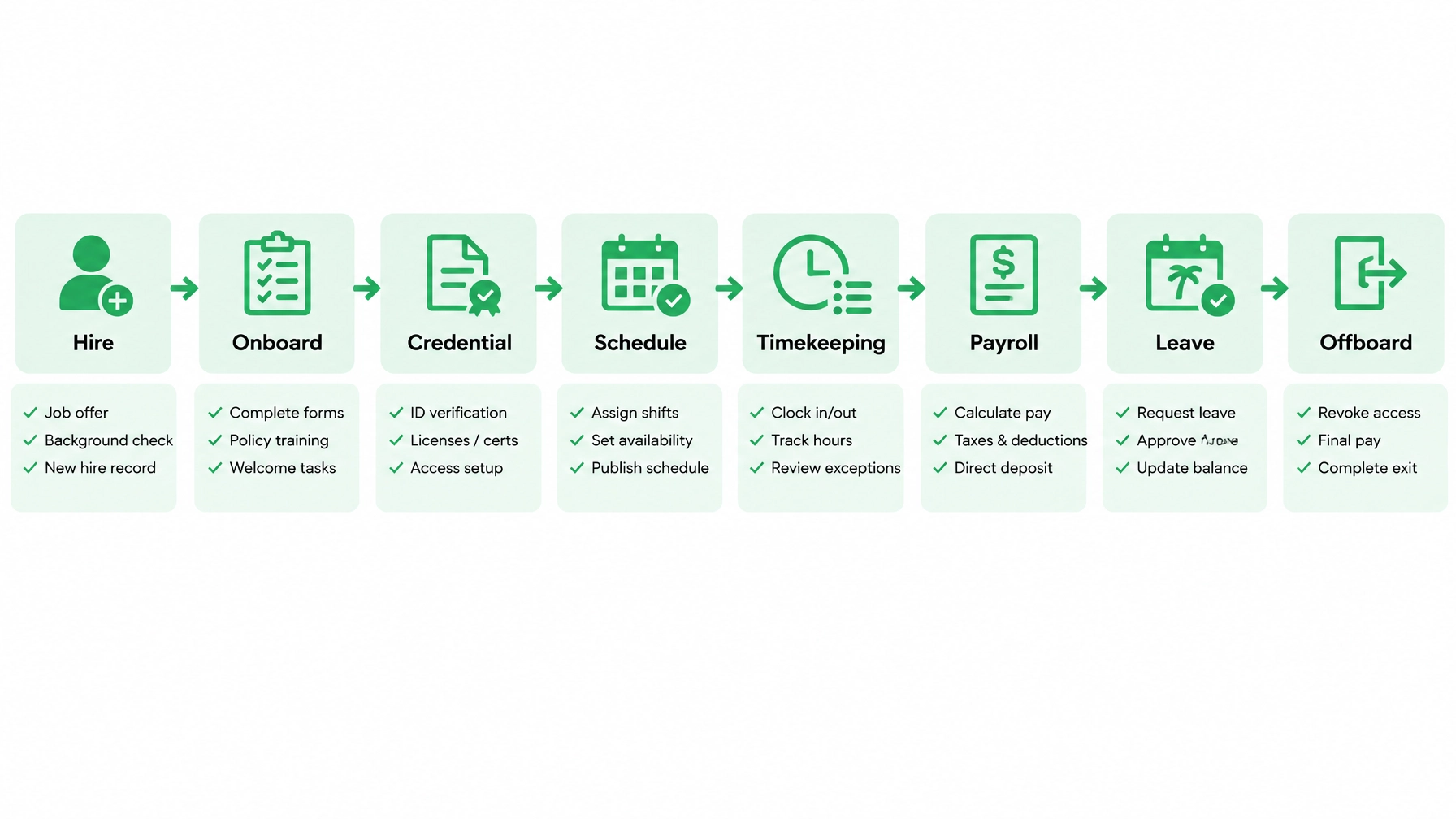
Why does HR feel manageable at 35 employees, then become fragile at 50?
The number is not magic. The real change is in the work. At 35 employees, a lot of HR work can still run on memory. A manager sends a text. Someone fixes a timecard by hand. A leave question sits in one inbox for a day and still gets handled.
At 50 employees, the same habits start to strain. You have more records, more handoffs, more exceptions, and less room for guesswork. The issue is not just paperwork. The issue is workflow.
An HR process that lives in one person’s head is not a process. It is a single point of failure, and it fails on the day that person is busiest.
That is why this stage feels different. The company did not just add headcount. It added operational load. If one person still carries the whole map in their head, then the company has built a dependency instead of a repeatable process.
Two different legal tests also start to matter around this point, and HR has to keep them separate. Under the U.S. Department of Labor’s FMLA guidance, FMLA applies to employers with 50 or more employees within 75 miles of the worksite. Under the IRS employer shared responsibility rules, the ACA employer mandate applies at 50 full-time equivalent employees. These are different tests. They do not trigger together by default.
That matters because HR must use the right rule for the right decision. HR now has to track headcount, work locations, hours, leave, benefits, and notices in a way that another person can follow. A spreadsheet can hold data. It cannot show ownership, timing, review, and completion by itself.
The first process to fix is the one that only one person understands.
In many companies, one HR generalist, office manager, or Head of People knows how the work really moves. That person knows how leave requests come in. They know where managers send time fixes. They know which spreadsheet tracks licenses. They know how payroll exceptions get cleaned up. They know which records are complete and which ones still need follow-up.
The problem is not the person. The problem is the dependency.
You can see the signs quickly. Managers use email, text, chat, and hallway talk for the same type of request. The same question comes back every week. No one can say where a request stands without asking HR. The process changes based on who asked and how busy the day feels. When that one person takes time off, work slows down.
That is not a people problem first. It is a system problem first.

This shows up early in specialty trade contractors. Credential and license tracking often breaks before leaders expect it to. A company may need to track OSHA training records, EPA credentials, state licenses, equipment qualifications, expiration dates, and role-based requirements. Not every contractor faces the same rules. Not every role needs the same proof. That is exactly why the process must be clear.
A loose spreadsheet feels good enough for a while. Then it becomes the only thing holding the work together. One person knows which tab is current. Another keeps a side list. Proof sits in email folders. A supervisor asks if a worker is cleared for an assignment, and HR has to stop everything to confirm it.
The risk is not only the missed date. The risk is the scramble. A missed expiration can delay an assignment. A missing record can slow project mobilization. An old spreadsheet can lead a manager to make the wrong call. When credential tracking depends on one person sorting through files, the company does not have control. It has a habit.
A stronger setup is simple. Keep one source of truth. Record the credential, the worker, the issue date, the expiration date, the proof, and the review owner. Set a routine review for upcoming expirations. Tie credential status to scheduling and assignment decisions.
Payroll and timekeeping usually break next. At this size, every pay cycle seems to bring repairs. Someone misses a punch. A manager changes a cost code late. Overtime needs review. Travel time raises a question. A correction shows up after payroll close. Every one of those issues needs a human fix.
That is why payroll starts to feel heavy. The team is not just running payroll. The team is clearing exceptions that should have had a cleaner path from the start.
There is a useful planning figure here, but it has limits. A vendor-compiled secondary estimate places manual payroll work at up to 12 hours per week, or about 624 hours per year, for companies in this size range. The same estimate says automation can recover about 70% of that time. This is not a first-party study. Treat it as a planning estimate, not as a universal result.
The better question is not only how many hours payroll takes. The better question is which exceptions repeat every cycle. If the same errors come back each pay period, then the workload is coming from process design, not just from volume.

Worker classification is another area where small habits become large problems. Many companies still treat classification as a label. They decide someone is a contractor, and the thinking stops there. The IRS guidance on independent contractors makes clear that a label does not decide status. The facts do. A key question is who controls what work gets done and how it gets done.
That means classification should work like a review process. It should not work like a one-time tag. When duties change, when control changes, when pay changes, or when the work setup changes, the company should review the facts again. It should also record why it made the call.
The exposure figures also need care. Under the Department of Labor penalty schedule, repeated or willful Fair Labor Standards Act minimum wage or overtime violations can carry civil money penalties of up to $2,515 per violation. For unintentional misclassification, IRS treatment can create roughly 10.7% of wages paid in federal tax exposure. Use that as a planning figure only. It is not a universal tax rate. In California, willful misclassification can bring penalties of $5,000 to $15,000 per violation. A pattern or practice of willful misclassification in California can raise that to $10,000 to $25,000 per violation. If a case is unclear, send it to employment counsel or a tax professional.
Workload also needs a better frame. Many HR teams say they are overloaded. That may be true. But overload often starts with broken flow. If the team answers the same question every week, checks the same record in three places, and fixes the same payroll issue every cycle, then the system is producing waste.
That strain shows up in market data. The HRO Today 2025–2026 report found that 80% of CHRO respondents were extremely or very concerned about fatigue and burnout across the HR function. That measures concern among CHROs. It does not mean 80% of HR professionals are burned out.
The trades add another layer of pressure. The BLS JOLTS construction data shows separations of about 4.0% per month, or roughly 48% annualized. That figure counts separation events, including quits, layoffs, and discharges. It applies to the construction sector, not specifically to specialty trade contractors. It also does not count unique individuals. Even with those limits, the message is clear. In labor-heavy settings, HR often handles a high volume of starts, stops, and changes.
So what should you fix first?
Start with ownership. Every repeat HR process needs a clear starter, reviewer, approver, and closer. If nobody can name those roles, work will drift.
Then fix critical records. Know where leave records live. Know where payroll records live. Know where credential proof lives. Know where classification decisions live. If records sit across inboxes, side spreadsheets, and local files, the process is fragile.
Then fix handoffs. Most delays happen between people. A manager submits incomplete data. HR waits. Payroll waits on HR. The problem is often not effort. The problem is that the next step did not get what it needed.
Then fix deadlines. Pay cycles have deadlines. Leave tasks have deadlines. Credential reviews have deadlines. Good operations do not depend on one person remembering them all.
Then fix exceptions. Every normal process needs a clear path for unusual cases. If there is no path, every odd case lands in one person’s inbox.
Then measure repeat failure. Count open requests. Count repeated payroll corrections. Count missing proof on credentials. Count which step fails most often. You do not need a perfect dashboard. You need enough visibility to spot the pattern.
A simple 30-day reset can help.
In week one, list your recurring HR processes. Mark the ones that depend on one person. Flag the ones tied to pay, leave, credentials, classification, and benefits.
In week two, draw the current workflow for one or two high-impact processes. Start with the request. Show each handoff. Name the owner at each step. Mark the record created at each step. Mark the deadline.
In week three, fix one process first. Pick the one with the biggest effect on daily work. Remove duplicate steps. Write plain instructions. Put records in one known place. Define what happens when the normal path does not fit.
In week four, test the process. Ask another trained person to run it from the written steps. Watch where they stop. Fix the unclear parts. Then review the first few cases and see what still comes back.
Well-run HR operations do not feel dramatic. They feel steady. Managers know where requests go. Employees know what happens next. Credential reviews happen before dates lapse. Payroll closes with fewer rescues. Classification questions trigger review instead of guesswork. The HR team gets more time for real leadership because less energy goes to repeat repair work.
The goal is to make HR run like a controlled operation: documented workflows, clear ownership, and measurable throughput.
Walton Global Enterprise is developing a private-sector HR operations model around this principle. Dr. Rayon L. Walton brings more than 25 years of Department of Defense leadership and operational experience to this work, along with an Ed.D. in Organizational Leadership and an MBA. The lesson carries across settings. When work is clear, owned, and documented, it becomes easier to run.
If you want, we can have a short conversation about how your HR processes actually run.
If only one person knows how HR works, the company does not have a process; it has a dependency.
Leave a Reply