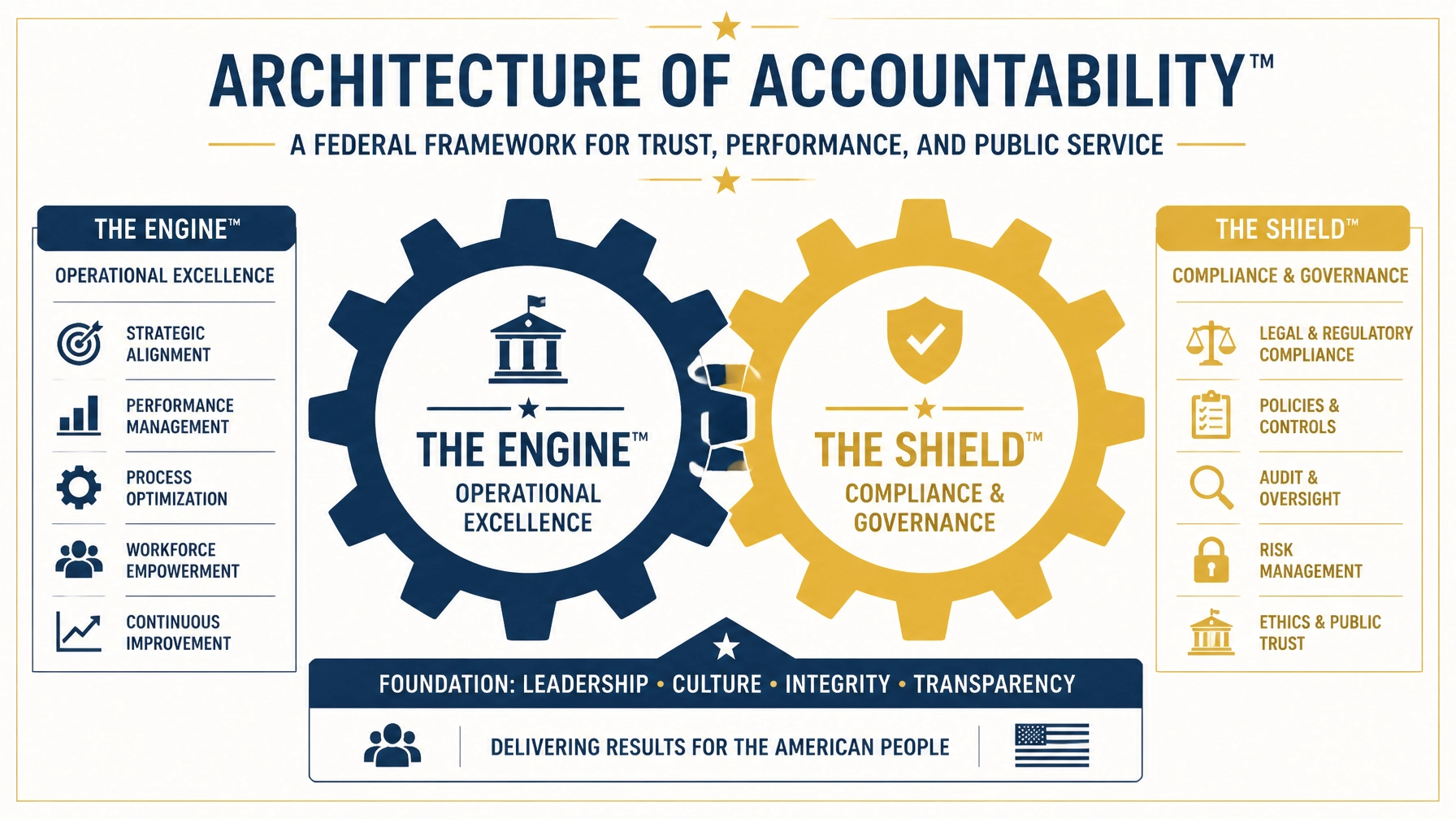
How does a leader scale a mission-critical operation without sacrificing the governance that keeps the organization safe? This is the central tension for every executive operating in a regulated environment. Scaling often feels like a choice between velocity and visibility: the faster you move, the harder it becomes to track compliance; the more you enforce compliance, the slower the organization moves.
Strategic leadership in an institutional context is not about managing people more intensely; it is about building a system that manages the work automatically. When operations are scaled correctly, governance is not an anchor that slows progress but the hull of the ship that allows it to navigate turbulent waters. To achieve this, leaders must shift their perspective from viewing governance as a list of requirements to viewing it as a high-performance operating system.
Step 1: Establishing Systemic Visibility through Governance
The first hurdle in scaling any operation is the "visibility gap." As programs grow in complexity, leaders often lose the ability to see the actual performance of internal controls. They rely on "Snapshots": static checks at a single point in time: rather than "Stress Tests" that show how the system performs under pressure.
In a high-impact environment, governance is the mechanism that provides this visibility. It is the process of defining exactly who is responsible for what, how those actions are documented, and how performance is measured. When these elements are standardized, scaling becomes a matter of duplicating the framework rather than reinventing the process. This executive mental model was developed by Walton Global Enterprise to help leaders interpret and operationalize principles reflected in the GAO Green Book, OMB Circular A-123, NIST guidance, and PMIAA implementation practices.
Step 2: Optimizing the Flow with THE ENGINE™
Operational excellence is the drive-train of the organization. Within the Walton Global Enterprise framework, this is known as THE ENGINE™. It represents the structured optimization of workflows, the elimination of waste, and the pursuit of Lean Six Sigma precision in every task.
Scaling operations requires more than just adding resources; it requires refining the sequence of delivery. When an organization scales a broken process, it merely scales its inefficiency. THE ENGINE™ focuses on building repeatable, documented pathways that ensure every program participant knows their role and the expected output. By institutionalizing these workflows, leadership can transition from tactical oversight to strategic enablement, trusting that the "Engine" will deliver consistent results regardless of the program's size.

Step 3: Protecting the Mission with THE SHIELD™
Efficiency without protection is a liability. While THE ENGINE™ drives the mission forward, THE SHIELD™ (Compliance & Governance) ensures the mission survives the scrutiny of auditors and regulators. In many organizations, compliance is treated as a post-hoc activity: something that happens after the work is done. In a strategic leadership model, compliance is the output of the work itself.
THE SHIELD™ integrates regulatory alignment and internal controls directly into the daily operational flow. This approach ensures that documentation is not an administrative burden but a natural byproduct of the process. When compliance is "built-in," the risk of mission disruption due to audit failure or regulatory breach is mitigated. This creates a secure environment where high-impact operations can expand without fear of catastrophic governance failures.

Step 4: Advancing from Compliance to Readiness
A common misconception among leadership teams is that being "compliant" is the same as being "ready." However, there is a critical progression that defines the maturity of an organization’s governance: Compliance → Assurance → Readiness.
- Compliance: "Did we satisfy the requirement?" This stage demonstrates that basic requirements have been met.
- Assurance: "Can we demonstrate our controls are working?" This stage moves beyond the check-box to provide evidence that the system is functioning as intended.
- Readiness: "Will those controls continue to perform when conditions change unexpectedly?" This is the highest level of maturity, demonstrating that the mission can continue even under extreme pressure or shifting regulatory landscapes.
Strategic leaders focus their energy on reaching the "Readiness" stage. It is the point where the organization is not just satisfying an auditor today but is prepared for the unforeseen challenges of tomorrow.

Step 5: Hardening Documentation via the Triple Check Protocol™
The final step in scaling high-impact operations is the institutionalization of quality through the Triple Check Protocol™. This is the audit-ready standard for documentation and quality assurance. In a scaled environment, errors in documentation can compound quickly, leading to systemic failures.
The protocol requires that every critical output is verified at three levels: accuracy of data, alignment with regulatory requirements, and mission-impact. By applying this rigorous standard, organizations create a culture of accountability where "good enough" is replaced by "audit-ready." This level of discipline is what separates a generic consulting approach from the structured, compliance-first operations delivered by Walton Global Enterprise.
When these five steps are integrated, the result is the Architecture of Accountability™. This overarching framework allows government agencies and institutional partners to operate seamlessly inside regulated, high-impact environments without disruption. It transforms the role of the executive from a manager of tasks into a steward of a high-performance system.
Why This Article Matters
- Time Investment: It provides a blueprint for scaling that bypasses the common pitfalls of rapid growth in regulated sectors.
- Decision Support: It helps leaders decide when to shift from tactical management to systemic governance.
- Misconception Correction: It clarifies that compliance is not an administrative burden but an operational advantage.
- Practical Outcome: Readers can immediately apply the Compliance → Assurance → Readiness model to assess their organization's current maturity.
Scaling is not about adding more work; it is about refining the system until the outcome becomes inevitable.
Leave a Reply