1. Article Classification:
- Type: Compliance & Operations (Problem-solving/Thought Leadership).
- Objective: To position Walton Global Enterprise (WGE) as the authority in governance and operational excellence, specifically helping federal grant recipients navigate the transition from "Uniform Guidance" to binding federal regulations.
2. Visual Strategy:
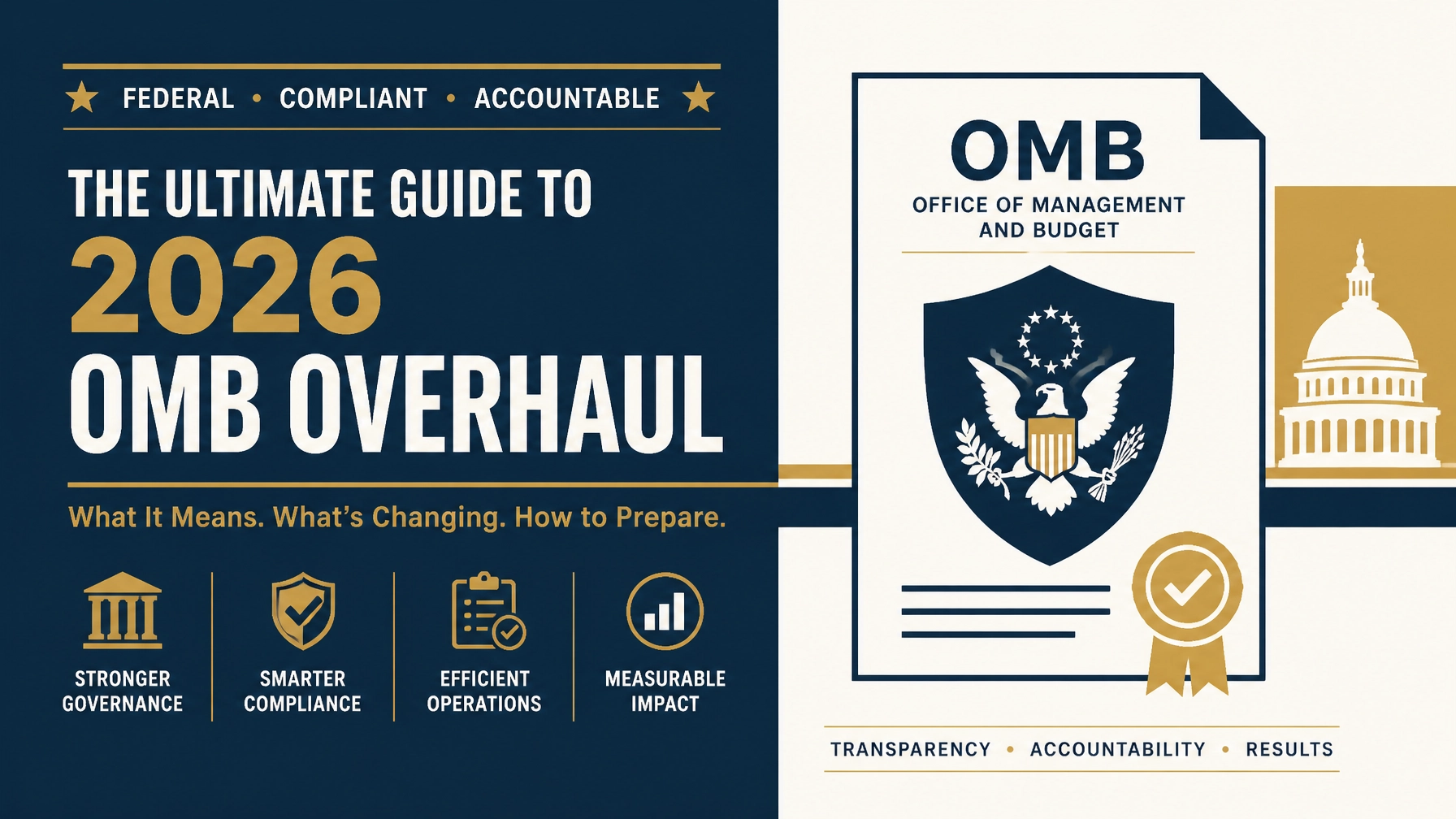
- Hero Image: Federal-grade schematic representing governance.
- Supporting Images: Visualizations of WGE proprietary frameworks: THE SHIELD™, THE ENGINE™, the Compliance → Assurance → Readiness progression, and the Snapshot vs. Stress Test mental model.
- Style: Minimalist, high-contrast, Navy/Gold/White palette.
3. Research & Context Integration:
- Authoritative Sources: OMB 2024 Uniform Guidance Revisions (2 CFR 200), OMB 2026 Proposed Rulemaking (Subtitle A rewrite), GAO Green Book, and PMIAA implementation practices.
- Internal Links: WGE Services, Entities We Power, and the Precision Over Pressure Clarity Guide.
4. Outline Quality Gate:
- Why This Article Matters:
- It clarifies the shift from non-binding guidance to binding federal law taking effect in 2026.
- It helps executives decide how to restructure internal controls to prevent "termination for convenience" under new agency powers.
- It corrects the misconception that audit thresholds are the only metric that matters.
- It provides a mental model (Snapshot vs. Stress Test) to evaluate organizational readiness.
The Ultimate Guide to the 2026 OMB Overhaul: Everything You Need to Succeed with Federal Grants
For many federal grant recipients, the question of compliance has long been a matter of satisfying the annual audit. But as we approach the 2026 fiscal year, a fundamental shift in the federal landscape is forcing a deeper question: Is our organization merely compliant with today’s rules, or are we operationally ready for the binding regulations of tomorrow?
The Office of Management and Budget (OMB) has initiated what is arguably the most significant overhaul of federal financial assistance since the inception of the Uniform Guidance. On May 29, 2026, OMB published a proposed rule that does more than just update thresholds; it seeks to reclassify 2 CFR Subtitle A from "guidance" into binding federal regulations. This shift means that future amendments will take effect government-wide instantly, and agencies will have expanded authority to suspend or terminate grants that no longer align with national policy or agency priorities.
The Shift from Guidance to Binding Regulation
Historically, 2 CFR 200 served as a framework that individual agencies adopted through their own rulemakings. The 2026 overhaul changes the legal DNA of grant management. By converting the Uniform Guidance into binding regulations, the federal government is signaling a move toward more rigid oversight and standardized enforcement.
For an executive leader, the operational implication is clear: the margin for error is shrinking. It is no longer enough to have documented policies that look good on paper. Organizations must now demonstrate that those policies are active, functioning, and resilient under pressure. This is where the distinction between documentation and execution becomes a matter of institutional survival.
At Walton Global Enterprise (WGE), we approach this landscape through the Architecture of Accountability™. This framework recognizes that governance is not a static checkbox but a dynamic operating system. To manage the 2026 overhaul, an organization must synchronize two core pillars: THE SHIELD™ (Compliance & Governance) and THE ENGINE™ (Operational Excellence).

Moving Beyond the Audit Threshold
The most visible changes in the 2024–2026 transition involve financial thresholds. The Single Audit threshold has increased from $750,000 to $1,000,000, and the equipment capitalization threshold has doubled to $10,000. While these changes provide some administrative relief, they often mask a more dangerous reality: the "Compliance Gap."
Organizations often focus solely on satisfying the auditor’s "snapshot" of a single fiscal year. However, the 2026 overhaul introduces new "national policy conditions" and expanded termination authorities. This means an agency could potentially terminate a discretionary grant if the recipient fails to meet evolving standards in areas like foreign collaboration disclosures or specific domestic preference requirements.
To navigate this, WGE utilizes a mental model developed to help leaders interpret principles reflected in the GAO Green Book and OMB Circular A-123: Snapshot vs. Stress Test.
A Snapshot asks: "Did we satisfy the requirement for this specific period?"
A Stress Test asks: "Will our controls continue to perform when agency priorities change or when national policy mandates a sudden shift in our procurement workflow?"
The Governance Progression: Compliance to Readiness
True excellence in a regulated environment requires moving through the WGE-defined governance progression: Compliance → Assurance → Readiness.
- Compliance: This is the baseline. "Did we satisfy the requirement?" It demonstrates that the rules were met at a specific point in time.
- Assurance: This is the evidence layer. "Can we demonstrate our controls are working?" It involves active monitoring and the Triple Check Protocol™: our audit-ready standard for documentation and quality assurance.
- Readiness: This is the peak of the Readiness Spectrum. "Will those controls continue to perform when conditions change unexpectedly?" Readiness means your organization can withstand the loss of a key staff member, a sudden audit from a different agency, or a shift in binding federal regulations without mission disruption.
 Assurance -> Readiness progression framework in a navy and gold palette.”>
This executive mental model was developed by Walton Global Enterprise to help leaders interpret and operationalize principles reflected in the GAO Green Book, OMB Circular A-123, NIST guidance, and PMIAA implementation practices. It moves the conversation from "avoiding a finding" to "sustaining the mission."
Operationalizing the 2026 Mandates
The 2026 overhaul also places a heavier burden on "pass-through" entities: those that receive federal funds and sub-award them to others. Under the proposed rules, there are strengthened reporting requirements to SAM.gov and a mandatory 10-day window for Inspectors General to transmit disclosures of criminal violations to the U.S. Attorney’s Office.
This heightened speed of reporting requires an "Engine" that is optimized for visibility. If your workflow for sub-recipient monitoring is manual or siloed, you cannot achieve the speed of disclosure required by the new regulations. You need a system where risk visibility is built into the workflow, not added as a post-script.
Dr. Rayon L. Walton, Founder of WGE, has spent his career building these types of operating systems. He understands that in high-impact, regulated environments, the "how" of the work is just as important as the "what." Our Strategic Advisory & Enablement services are designed specifically to help organizations align their internal "Engine" with the federal "Shield."
Implementing a Performance-First System
As you prepare for the October 1, 2026, effective date, the action plan should not be to simply rewrite your handbook. It should be to pressure-test your execution.
- Audit your internal thresholds: Ensure your procurement and asset management policies align with the new $10,000 equipment limit, but don't stop there.
- Evaluate your termination risk: Review your current discretionary awards against the new agency authorities. Do your programs show a clear, documented alignment with mission-critical national interests?
- Standardize the Triple Check Protocol™: Ensure that every piece of documentation is not just present, but verifiable and consistent across all departments.

The transition from guidance to regulation is a signal that the federal government is prioritizing performance over mere participation. Organizations that treat this as a "paperwork exercise" will find themselves vulnerable when the next audit cycle: or the next policy shift: occurs. Those that view it as an opportunity to build a high-performance operating system will find themselves more resilient and more competitive for future awards.
We help organizations improve operational performance through governance, accountability, workflow optimization, and compliance-focused execution. The 2026 overhaul is not a hurdle; it is the new standard for the Architecture of Accountability™.
Governance is the operating system that transforms compliance from a burden into a competitive advantage.
Leave a Reply